

Contract Management and Project Delivery Success of Ministries, Departments and Agencies (MDAs) in Bayelsa State, Nigeria
- a University of Port Harcourt
Highlights
- Examines the relationship between contract management and project delivery success among MDAs in Bayelsa State.
- Analyses contract management practices using responses from 197 procurement-related respondents.
- Establishes significant positive relationships with reduced project costs (r=0.532), timely delivery (r=0.583), and high-quality delivery (r=0.896).
- Recommends stronger contract monitoring, dispute resolution, and enforcement of procurement regulations.
Abstract
This study investigated the relationship between contract management and project delivery success in the Bayelsa State public service. The study adopted a correlational research design; and the study population consisted of one hundred and forty- seven (147) ministries, departments and agencies (MDAs) operating in Bayelsa State. The sample size of 107 was determined using the formula suggested by Yamane (1967). The purposive sampling was used to select two principal procurement officers from each of the MDAs operating in Bayelsa State making a total of two hundred and fourteen (214) respondents. However, one hundred and ninety-seven (197) respondents were retrieved and used for analysis. The Spearman’s correlation coefficient was used to analyze data retrieved from respondents with the aid of Statistical Package for the Social Sciences (SPSS) version 26.0. The results indicated that contract management has a moderate and strong positive and significant relationship with the measures of project delivery success (reduced cost project delivery, time bound project delivery and high- quality project delivery) in the Bayelsa State public service. Therefore, we concluded that the MDAs in Bayelsa State should adopt contract management in order to maintain project delivery success in the procurement processes. It was recommended that the MDAs should give emphasis to exploiting contract management practices for better project performance as effective enforcement of procurement regulations will enhance transparency, accountability, and efficiency in project delivery.
Keywords
The process of contract management is
not only about procurement and contract award. It encompasses the processes
involved in a contract before, during and after the execution, such as contract
planning; defining clear contract specifications; identifying contract risks;
coordinating with contractors; tracking contract milestones; verifying
completed work; managing payments; documenting variations; and assessing final outcomes
(Huddleston & Eom, 2019; Peters, Stewart, & Weese, 2019). These
activities are intertwined. Ambiguous contractual conditions can lead to
misunderstandings when implementing, and insufficient monitoring can leave
deviations from the contract specifications unnoticed. Likewise, the delay in
certification of final work or inadequate communication among project
participants may interfere with implementation plans. Contract management
should therefore be considered as a management process that a public institution
carries out continuously to ensure that contractual performance matches project
goals. According to Obayi, Koh, Oglethorpe, and Ebrahimi (2017), the
implementation of contract management within an organization has the potential
to improve various aspects of its operations, including its influence, supplier
relationships, product quality, efficiency, flexibility, and overall
productivity. Contract administration is an important aspect that contributes
to successful outcomes in the procurement processes of public sector
organizations (Waigwa & Njeru, 2016).
Successful delivery of the project is
also a critical measure of the effectiveness of public sector management. It
reflects the extent of a project to achieve its objectives and generate
required outputs within agreed time, cost and quality criteria. In UK, Fapo'
hunda and Stephenson (2015) conducted a study and found that disagreement
regarding cost, time, and value for the projects' objectives would affect some
projects. The process of assessing how efficiently and effectively activities
were carried out within the project was known as project performance
measurement (Dainty, Cheng & Moore, 2019). While these three dimensions are
common in their use when assessing a project for delivery, they are not the
only ones that can form part of the criteria for success; other measures of
project success can include compliance with contractual specifications,
functionality of completed facilities, stakeholder satisfaction and the
delivery of the intended public value. Effective project delivery requires
careful planning, efficient resource management, and adept problem-solving
skills from experienced project professionals. If the project is finished on
budget but does not have the required technical specifications, it is not
considered a complete success. Similarly, a technically adequate project that
is not completed by the time it is supposed to be finished may negatively
impact on public service delivery. Project success is used to assess a project
based on key performance indicators to know if it is successful or not. Project
success can only be judged by both performance in project implementation and by
how well the finished product meets the project's goals.
Scholars are of the view that contract
management practices predict project delivery success and this view instigated
previous studies that sought to explain the connection between contract
management and project delivery success. For instance, Gatsinzi, and Nnamdi
(2024) evaluated the effect of procurement contract planning, negotiation and
execution on the performance. Mbaya and Ndolo (2024) assessed the effects of
contract management practices on performance of market development projects.
Openji and Osoro (2024) aimed to investigate the process of projects contract
management and performance of water contract. Therefore, this study aims to
empirically examine the relationship between contract management (planning,
monitoring, and dispute resolution) and project delivery success in the State
of Bayelsa (Hassan and Omwenga 2023).
Specific objectives were to:
i
Assesses
the relationship between contract management practice and reduced project
delivery cost of MDAs in Bayelsa State.
ii
Examine the
relationship between contract management practice and time bound project
delivery of MDAs in Bayelsa State.
iii
Investigate
the relationship between contract management practice and high-quality project
delivery of MDAs in Bayelsa State.
The study aimed to offer a blueprint
for improving the governance of public contracts and public funds, thereby
mitigating the threats of substandard performance (Musau & Chege, 2025). In
addition, the findings of this study suggested possible policy recommendations
to enhance public infrastructure procurement by addressing specific administrative
shortcomings that lead to cost overruns and delays in infrastructure
construction (Changalima et al., 2022; Osifo et al., 2025). The study
identified these systemic obstacles and lays a crucial foundation for
understanding how accountability in institutions is linked to the effective
implementation of government interventions. Finally, this study contributed to
the vast body of knowledge on procurement-performance linkages as it brings
about a gap in empirical studies related to contractual oversight in the
context of Bayelsa State (Ackah & Sekyi-Ansah, 2026; Chege & Musau,
2025).
Contract Management Practice
According to Hutchison et al. (2018), contracts are agreements that parties enter into voluntarily and that are intended to create legally binding commitments. As described by Kolani and Miroga (2019), contract management is the systematic practice of enforcing contract terms and ensuring the correct, timely fulfilment of obligations by all involved parties. Njoki et al. (2021) note that contract management is a crucial component of public procurement processes because it promotes transparency, accountability, and fair treatment of contracts across different government levels. By managing contracts, the project manager and the supply chain can clarify expectations, coordinate stakeholders, logistics support, and procurement arrangements, and reduce in most cases, eliminate commercial ambiguity. This transparency lowers the likelihood of disputes and strengthens project and supply chain performance. Effective contract management also includes assessing vendor performance against established contract terms to support the successful completion of projects. Successful and efficient contract management practices meet the needs of the organization’s stakeholders, create optimal conditions and value in relation to the scarce allocation of taxpayers’ resources, commonly referred to as best value for money, and ensure the prudent and effective availability of funds (Oluka & Basheka, 2014). In today’s business environment, where organizations are narrowing their supplier pool, overseeing a single supplier contract requires strategic decision-making, since the supplier becomes the sole source for the products or services necessary for the organization’s operations (Hugos, 2012). The central objective of contract management is to ensure the efficient and effective use of resources while minimizing waste, inefficiency, maladministration, and corruption (Odulana & Oyewobi, 2019). Indicators of contract administration include clearly stated expectations, specifying scope and deliverables, preparing detailed timelines for each contract milestone, planning budget allocations, and anticipating risk (Hackett & Statham, 2016). Managing contract conflict entails risk management, where users and suppliers work together to identify possible conflicts or performance barriers so that they can be addressed and mitigated (Davison & Wright 2004) as cited in Hassan and Omwenga (2023). An effective contract monitoring process involves training staff in contract monitoring, establishing clear written policies and procedures, maintaining organized contract files, making payments based on satisfactory performance, requiring regular programmatic reports from the vendor, conducting on-site monitoring, applying incentives and consequences for poor performance, providing access to records and the right to audit, and following closeout procedures. Project delivery success encompasses the full lifecycle of a building facility, a project, or other project types from conception to completion (Design- Build Institute of America, 2018). A project is considered successful if it is completed within budget, meets quality requirements, stays on schedule, and is carried out safely. Project delivery success (PDS) results from project implementation processes and can be summarized as ‘doing the project right.’ Consequently, project success is linked to project performance. According to (Ogunsanya, 2018), performance is the level of achievement of an endeavor or effort, and it relates to the predetermined goals or aims that form the project parameters. According to PMI (2017), project delivery performance refers to the extent to which a project is delivered and completed effectively and efficiently within the limits of time, budget, quality, scope, and other key performance indicators, in order to achieve the project’s intended aims. Project performance is demonstrated through the main criteria that indicate whether the project is successful or not—namely, the project’s scope, time, cost, and quality (Zhang et al., 2024). It reflects the efficiency and effectiveness of project delivery, and a successful project will meet the expectations of its stakeholders. Ogunsanya (2018) states that, from a project management standpoint, project success is defined as the degree to which a project can satisfy the needs and expectations of its stakeholders. Project Delivery Success (PDS), therefore, is a subset of overall project success. Accordingly, this study used reduced cost project delivery, time bound project delivery, and high-quality project delivery as measures of project delivery success (Figure 1).
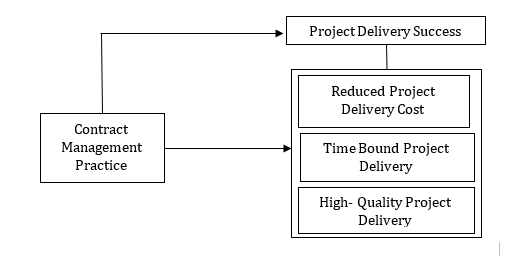
Figure 1: Conceptual Framework
Reduced Cost
Project Delivery: As Lucey
(1996), cited in Akeem (2017), explains, reduced cost is a notion aimed at
lowering costs from a previously accepted norm or standard without diminishing
the effectiveness or performance of the project or services. According to
Asaolu and Nassar (2007), reduced cost is a planned and positive approach to
improving efficiency. It can be understood in various ways, including increased
productivity and reduced waste. It involves real and sustained reductions in
the unit cost of goods or services provided, without negatively affecting
suitability for the intended use and without reducing product quality. The goal
of cost reduction is to determine whether savings in the cost of materials,
labour, and overheads can be achieved at all. Cost reduction may be directed
toward lowering the expected cost level—bringing the cost below the current
budgeted or standard level—through actions such as purchasing new equipment,
changing the working methods, and so forth (Isoghom & Worgu, 2025).
Time bound
Project Delivery: Timely
delivery, meaning the successful completion of a project within a
pre-determined timeframe, is regarded as the ultimate measure of success.
Anbari (2003) considers the timely delivery of a project to reflect the
contractor’s ability to accomplish the major goals of the project within the
established project time. The time required to carry out project tasks from the
commencement of work on site to the delivery of the project is referred to as
project duration. A project may be deemed successful when it is completed
within budget, on schedule, in line with specifications, and in line with
stakeholder satisfaction (Johnson & Babu, 2018). Time is becoming
increasingly important for firms because it is frequently used as a key
benchmark for both project performance and project organization efficiency. For
any project, one of the most critical determinants of its success is the time
factor.
Timely completion is a critical factor in project
delivery, and it cannot be compromised, because it shapes a general perception
of the expected progress of the project and reduces delays during
implementation. Projects therefore need to be scheduled within fixed
timeframes, each with a distinct start and end date. The better time is
managed, the more efficient the project will be, provided that all other
processes remain unchanged (PMI, 2017). High-Quality Project Delivery: ISO 9000
(2015) describes quality as the totality of characteristics of an entity that
bear on its ability to satisfy stated or implied needs. Sahil and Samiksha
(2020) define quality as the extent to which a set of inherent characteristics
meets requirements. Quality is a fundamental element of a successful
organization. In the context of Quality, both processes and results are
important. A strong process yields a strong product, and a good product is
produced through a good process. Project quality includes the processes and
activities required to establish quality policies, objectives, and
responsibilities for a project so that it will meet the needs for which it was
created. Being able to consistently and reliably achieve client satisfaction is
closely linked to the quality of the project, and implementing a quality
management system is a key tool. Consequently, having accurate and clearly
defined requirements is the only route to determining whether the product
achieves high quality and value for project stakeholders. Empirical Review The
study by Songa and Akumuntu (2024) examined the relationship between contract
management practices and public procurement performance in MINEDUC from 2020 to
2022. The study population comprised 212 MINEDUC employees. A simple random
sampling approach was used to select the respondents. The Taro Yamane formula
was then applied to compute a sample size of 128. Data were gathered using
questionnaire administration and documentary research methods. The findings
indicated that the effective probabilities of contract negotiation, contract
execution, and contract monitoring and evaluation for MINEDUC in the long run
are all below 10%. Mbaya and Ndolo (2024) assessed how contract management
practices affect the performance of market development projects in Meru County,
Kenya. The study adopted a descriptive research design. The respondents were
410 officials directly involved in project implementation, selected through simple
random sampling. Descriptive and inferential statistics were both used to
analyze data collected from the questionnaires in order to draw meaningful
conclusions. The regression model coefficients suggested a weak effect of
contract management that was not statistically significant. In addition, Openji
and Osoro (2024) sought to investigate the relationship between contract
management and the performance of water contracts in Baringo County, Kenya. The
study used a descriptive research design and employed both qualitative and
quantitative approaches. The target population consisted of 200 respondents who
were managers of water projects in Baringo County. Purposive random sampling
was applied in this study. This study was conducted as a census survey.
The study used both open-ended and closed-ended
questionnaires as its data collection method. Structured questionnaires were
employed to obtain primary data. Secondary data were obtained from
institutional documents, Ministry of Water publications within the County, and
relevant publications in reviewed journals. The data were analyzed using
descriptive and inferential statistics. Statistical analysis was conducted
using analysis of variance (ANOVA), t-tests, Pearson correlation, p-values, and
the coefficient of determination. The findings of the study confirm the
relationship between the independent and dependent variables. Shadrack et al.
(2024) examined the effect of procurement contract administration on the
quality achievement of force account (FA) construction projects in Local
Government Authorities (LGAs) in Tanzania. The study adopted a cross-sectional
research design. It involved 318 respondents, and the data were analyzed by
implementing partial least squares structural equation modelling (PLS-SEM). The
results indicate that the factors of risk management, relationship management,
dispute management, and monitoring and control are positive and significant in
explaining the quality achievement of FA construction projects. Notably, risk
management is the factor most likely to predict the quality achievement of FA
construction projects. It was concluded that the quality achievement of FA
construction projects is strongly influenced by procurement contract
administration.
Theoretical
Foundation
This study is grounded in principal-agent theory.
Principal-agent theory is an agency theory proposed by American economists
Michael Jensen and William Meckling in 1976 (Jensen & Meckling, 1976),
addressing situations in which the principal can require the agent to undertake
activities for the principal’s benefit, though not necessarily for the agent’s.
The theory depicts the relationship between a contractor or supplier and the
buyer (principal) acting as an agent (Maiga et al., 2016). Agency theory is
important for understanding and managing relationships between principals and
agents, or between principals and agents acting on their behalf, across
different contexts, including corporate governance, agency contracts, and
agency partnerships. Williamson (2013) argues that contract management problems
arise from the relationships in which a principal (contracting government)
contracts with an agent (vendor) to produce goods and services in which the
agent has expertise. The principal seeks to ensure that the agent does not
exploit its information advantage by establishing appropriate contracts,
providing incentives, and requiring that the agent performs what is stipulated
in the contract. Nonetheless, several rather stringent conditions must be
satisfied to enable a strong and effective market. In this study, the theory is
applied by showing that involving key actors in the contract management and
procurement process—for example, suppliers, employees, and potentially external
experts—can lead to improved and more sustainable procurement performance.
According to principal-agent theory, governments and contractors must share the
same objectives. Involving stakeholders in the contract development and
implementation process helps to draw on a range of perspectives, local perceptions,
and procurement success commitment from ministries, departments, and agencies
(MDAs). In view of the foregoing, the study’s null hypotheses were developed
based on the specific objectives;
H01: Contract management practice does not
significantly relate with reduced project delivery cost of MDAs in Bayelsa
State.
H02: Contract management practice does not
significantly relate with time bound project delivery of MDAs in Bayelsa State.
H03: Contract management practice does not
significantly relate with high-quality project delivery of MDAs in Bayelsa
State.
Materials
and Methods
The correlational research design was used for testing the nature of relationship between variables. The research used in this study is survey method and data type is cross sectional data, which is taken at one point in time. The survey method is selected for this study because the aim of the study can be well measured in order to reach a logical conclusion. The study population for this study comprised 147 MDAs in the public service of Bayelsa State. The sample size of 107 was determined using the formula suggested by Yamane (1967). Purposive sampling was used to select the respondents who had enough knowledge of procurement procedures and project implementation. This approach ensured that only individuals with direct involvement in public procurement activities participated in the study, thereby enhancing the relevance and reliability of the data collected. Hence, two principal procurement officers from each of the MDAs operating in Bayelsa State were selected as respondents for the study, making a total of two hundred and fourteen (214) respondents. The primary data were collected using the questionnaire. The questionnaire was deemed suitable because it is easy to be administered, it is not too expensive and can be used for the collection of a large amount of data. In addition, they also provide the possible anonymity of respondent, and no interviewer bias when handled properly. The questionnaire was designed using a multiple items measurement scale. The study instrument was measured using a 5-point Likert scale, and the reliability of the instrument was examined by conducting a Cronbach alpha reliability test. A threshold of 0.70 established by Nunally (1978) was adopted in determining the reliability of the research instrument. In addition, the three hypotheses were tested using the Spearman's correlation coefficient (rho) with a significance level of 0.05, all analyses were conducted using the statistical package for social sciences (SPSS) version 26.0.
Results and Discussion
The findings for this investigation are reported in this section of the study. From the total of 214 copies administered, only 197 copies were identified as substantial and suitable for the research. Presented in Table 1 is the result for the reliability test for the instrument of the variables.
Table 1:
Result for reliability test
|
Variables |
Items |
Coefficients |
|
Contract Management |
4 |
0.897 |
|
Reduced Cost Project Delivery |
4 |
0.950 |
|
Time- bound Project Delivery |
4 |
0.922 |
|
High- quality Project Delivery |
4 |
0.898 |
Source: SPSS Output from Survey
Research
The
reliability analysis of the research instrument is shown in Table 1. As shown
in the Table, all the variables in the study have high Cronbach’s alpha
reliability coefficients that surpass the minimum acceptable level (0.70) set
by Nunually (1978). The implication is that, if this study is carried out again
in a similar context the results will be similar to the results in this study. Table
2 illustrates the result for the univariate data analysis on the predictor
variable properties and dimensions.
Table 2: Data Distribution for Contract Management Practices
|
|
|
N |
Mean |
Std. Deviation |
|
Contract
Management |
We manage
contracts fairly and justly. |
197 |
3.9442 |
.65616 |
|
We
regularly monitor and evaluate contracts to ensure timely delivery of
projects. |
197 |
4.3350 |
.84482 |
|
|
We
consult our legal team before signing contracts. |
197 |
4.3350 |
1.09705 |
|
|
We
promptly resolve disputes arising from the contract. |
197 |
3.9442 |
.65616 |
|
|
|
Valid N
(listwise) |
197 |
|
|
Source: Research Data (2026)
Analysis on
the data distribution for the properties of contract management, reveals that
the participants identify the indicators of contract management as true, and as
characterizing the behaviour of the organisation. From the analysis, it is
revealed that participants affirm to these indicators as reflecting notable
practices and functions within the public organisation. The result affirms to
contract management (x = 4.1396 and SD = 0.72812). The result from the analysis
indicates that contract management can be considered the reality of the MDAs,
and as factor that indicate the nature of procurement practices within the
organisations. Presented in Table 3 is the data distribution for the properties
and measures of project delivery success.
Table 3: Data Distribution for Project Delivery Success
|
|
|
N |
Mean |
Std. Deviation |
|
Reduced
Cost Project Delivery |
Our procurement cost has reduced |
197 |
3.9442 |
0.65616 |
|
We offer prices as low or lower than
our competitors. |
197 |
3.9086 |
0.77708 |
|
|
Our overhead cost has reduced. |
197 |
3.8731 |
0.58827 |
|
|
Our transportation cost has reduced. |
197 |
4.3706 |
0.85102 |
|
|
Time
Bound Project Delivery |
Our institution can quickly complete
project to meet customer’s needs. |
197 |
4.3706 |
1.10183 |
|
Our institution has an outstanding
time delivery record to our customers |
197 |
3.9797 |
.68482 |
|
|
We are able to reduced development
lead time |
197 |
3.9086 |
.77708 |
|
|
We have an effective time management
practice |
197 |
3.8731 |
.58827 |
|
|
High
Quality Project Delivery |
We offer projects of high quality to
our partners |
197 |
4.2995 |
.83706 |
|
|
We are able to compete based on
quality. |
197 |
4.3350 |
1.09705 |
|
|
We offer projects that are durable. |
197 |
4.0152 |
.71054 |
|
|
We always comply with all quality
standards |
197 |
3.9797 |
.82659 |
|
|
Valid N (listwise) |
197 |
|
|
Source: Research Data (2026)
The result
for the analysis on the properties of project delivery success, indicates that
participants consider the indicators as true and as characterizing the MDAs in
Bayelsa State. The related features or attributes of project delivery success
are shown to be evident and as true in terms of the behaviour of the MDAs. From
the analysis, it is shown that reduced cost project delivery (x = 4.0241 and SD
= 0.67649), time bound project delivery (x = 4.0330 and SD = 0.73030) and
high-quality project delivery () x = 4.1574 and SD = 0.76930), are all
demonstrated to be characteristics of the MDAs in Bayelsa State. The result
offers a position that clarifies on the capacity of the related organisations;
demonstrating the extent to which these organisations demonstrate competence in
their handling and completion of project goals, particularly project delivery.
The test
for the role of contract management in the outcome of project delivery success
is carried out in this section. Table 4 presents a Spearman correlation matrix
examining the relationships between contract management practice and project
delivery success in terms of reduced project cost, time bound project delivery
and high- quality project delivery of MDAs in Bayelsa State. The results show
strong, positive and statistically significant correlations between contract
management practice and the measures of the criterion variables. Contract
management practice exhibits a moderate positive relationship (r = 0.532, p =
0.000 < 0.05) with reduced project delivery cost, indicating that effective
contract management practice is associated with project delivery success in
terms of reduced project delivery cost. Similarly, contract management practice
demonstrates a moderate positive relationship (r = 0.583, p = 0.000 < 0.05)
with time bound project delivery, indicating that good management of contract
corresponds to improved project delivery outcomes in terms of time bound
project delivery. Additionally, contract management practice shows a
significant positive relationship (r = 0.896, p = 0.000 < 0.05) with
high-quality project delivery, highlighting the importance of effectively
adhering to quality standards to influence positive project delivery outcomes
in terms of high- quality project delivery. The low p-values indicate that the
observed associations are unlikely to have occurred by chance, affirming the
reliability of the positive correlations observed between contract management
and the different aspects of project delivery success.
Table 4: Contract Management and Project Delivery Success
|
|
Contract
Management |
Reduced
Cost Project Delivery |
Time
Bound Project Delivery |
High-Quality
Project Delivery |
||
|
Spearman's
rho |
Contract Management |
Correlation Coefficient |
1.000 |
.532** |
.583** |
.896** |
|
Sig. (2-tailed) |
. |
.000 |
.000 |
.000 |
||
|
N |
197 |
197 |
197 |
197 |
||
|
Reduced Cost Project Delivery |
Correlation Coefficient |
.532** |
1.000 |
.369** |
.713** |
|
|
Sig. (2-tailed) |
0.000 |
. |
.000 |
.000 |
||
|
N |
197 |
197 |
197 |
197 |
||
|
Time Bound Project Delivery |
Correlation Coefficient |
.583** |
.369** |
1.000 |
.783** |
|
|
Sig. (2-tailed) |
0.000 |
.000 |
. |
.000 |
||
|
N |
197 |
197 |
197 |
197 |
||
|
High-Quality Project Delivery |
Correlation Coefficient |
.896** |
.713** |
.783** |
1.000 |
|
|
Sig. (2-tailed) |
0.000 |
0.000 |
.000 |
. |
||
|
N |
197 |
197 |
197 |
197 |
||
**. Correlation
is significant at the 0.01 level (2-tailed).
Discussion of
Findings
The relationship between contract
management and project delivery success is observed to be significant.
Specifically, contract management is found to significantly improve the outcomes
of cost reduction project delivery, time-bound project delivery, and
high-quality project delivery. Contract management forms an essential component
of public procurement practices because it entails shaping relationships and
platforms through which the views of suppliers are incorporated by ministries,
departments, and agencies (MDAs) into their procurement processes. The study
further established that the relationship between contract management and
indicators of project delivery success (cost reduction project delivery,
time-bound project delivery, and high-quality project delivery) was moderate
and very strong positive, with correlation coefficients of 0.532, 0.583, and
0.896, respectively, at a probability level below the stated alpha value of 0.05
(p= 0.000< 0.05), as presented in table 4 above. The results therefore
indicate a moderate, positive, and statistically significant relationship
between contract management and cost reduction project delivery among
government ministries, departments, and agencies (MDAs) in Bayelsa State. This
implies that stronger contract management practices are associated with higher
project delivery success for MDAs in Bayelsa State. The findings of this study
align with those of earlier research. In particular, they corroborate the
findings of Songa and Akumuntu (2024), who reported that public procurement
performance is explained by effective processes of contract negotiation,
contract execution, contract monitoring, and evaluation. Contract management is
crucial for lowering costs and improving procurement performance within
organizations. Without proper contract management, savings are significantly
reduced and customers experience frustration. This suggests that contract
management practices enable both parties to a contract to meet their respective
obligations as efficiently and effectively as possible, in order to achieve the
business and operational objectives required under the contract and, notably,
to deliver value for money. Cost reduction is a critical element of supply
chain management. By understanding supply chain costs, implementing cost
reduction strategies, and assessing performance, organizations can strengthen
their bottom line, increase profitability, and obtain a competitive advantage.
Similarly, the results of the statistical analyses showed that contract
management practices have a moderate, positive, and statistically significant
association with time-bound project delivery. These findings support the view
that successful and efficient contract management practices are those that meet
the needs of the organization’s stakeholders, including achieving optimum
conditions and value in relation to the allocation of scarce taxpayers’
resources, otherwise termed best value for money, and ensuring the rational and
efficient availability of funds (Oluka & Basheka, 2014). The current
findings also support the results of Mbaya and Ndolo (2024), which found a
positive relationship between contract management and the performance of market
development projects, and those of Openji and Osoro (2024), which reported that
projects’ contract management is strongly correlated with projects’
performance.
Inadequate lead times can reduce
visibility and lead to overstocking, stock-outs, and additional delivery costs
for express deliveries meant to overcome these problems. Lead time is a key
metric for assessing the supply chain. Extended lead times can increase
inventory levels, which may raise costs and lower productivity. Safety stock is
a buffer inventory that organizations keep on hand to meet customer demand even
when delays occur in the supply chain. Maintaining excessive safety inventory
can also immobilize capital and increase storage costs; therefore, companies
should work to keep their inventory levels as low as possible. Hence, MDAs that
do not deliver as required in the contract lose future business due to a
consistent pattern of project delivery failure, and consequently they may miss
opportunities for contract renewals. Analysis of the results showed a very strong,
statistically significant relationship between contract management practices
and high-quality project delivery. These findings are consistent with those of
Shadrack, et al., (2024), which indicate that the quality of construction
projects is strongly influenced by procurement contract administration. Based
on the evidence provided, it is affirmed that projects can be implemented at a
high, preferred rate and that the likelihood of creating value in terms of
value for money is realized, contract variations are handled in a specific and
agreed manner, and the probability of new risks emerging during project
implementation is reduced. Project implementation is often and routinely
carried out to confirm that suppliers deliver goods and services according to the
schedule and in line with the procurement plan, and that quality is achieved,
especially in contracts that are the highest risk or most complex. Products,
services, and public works are delivered and accepted once they satisfy the
acceptance criteria defined during contract development and set out in the
specifications, scope of works, or terms of reference. Payments are made, and
the amounts paid correspond to work that has been fully and adequately
implemented. Meanwhile, problems arising during contract execution are
addressed promptly and effectively, which usually reduces the tension between
MDAs and contractors and thereby improves project performance. These findings
provide a sound basis for rejecting the null hypothesis. Therefore, contract
management must be emphasized at every point of project delivery success in
government ministries, departments, and agencies (MDAs).
Conclusion and Recommendations:
Based on the results obtained from the
empirical tests and the discussion of findings above, the study concluded that
contract management actions are essential for governing the buyer–supplier
relationship. Contract management strengthens partners’ commitment to success
and ensures shared responsibility for the outcome of decisions.
This is
crucial for achieving healthy exchanges between MDAs and their suppliers,
bridging differences and strengthening a common voice to market realities that
boost the profitability of MDAs, minimise risks (due to giving accurate
information) and improve efficiency and effectiveness (contributing to a
project delivery success in terms of reduced project delivery cost, time-bound
project delivery and high-quality project delivery of the MDAs in Bayelsa
State) of the MDAs. Therefore, it is recommended that the MDAs should give
emphasis to exploiting contract management practices for better project
performance. This can be done through use of appropriate validation and
certification tools, optimizing the contract identification process with
multiple suppliers, minimizing legal service costs, avoiding unanticipated
service renewals, tracking key project milestones, and taking advantage of
automated functionality and alerts. Effective enforcement of procurement
regulations will enhance transparency, accountability, and efficiency in
project delivery. Government agencies should keep track of contractor
performance based on timely delivery and quality standards.
Declaration of Competing Interest
The authors declare that they have no
known competing financial interests or personal relationships that could have
appeared to influence the work reported in this paper.
References
Ackah, D., & Sekyi-Ansah, J. (2026), The Role of supplier relationship management in enhancing procurement efficiency in oil and gas engineering projects, African Journal of Procurement, Logistics & Supply Chain Management, 9(1), 36-54.
Akeem, L. B. (2017). Effect of cost control and cost reduction techniques in organizational performance. International Business and Management, 14 (3), 19-26.
Anaba, D. C., Kess-Momoh, A. J., & Ayodeji, S. A. (2024). Strategic negotiation and contract management: Best practices for high-stakes projects. International Journal of Applied Research in Social Sciences, 6(7), 1310-1320.
Anbari, F.T. (2003). Earned value project management method and extensions. Project Management Journal, 34(4), 12-23.
Asaolu & Nassar. (2007). Essential of management accounting and financial management, 2nd edition. Ile-Ife, Nigeria: Cedar Productions Ltd.
Changalima, I. A., Mchopa, A. D., & Ismail, I. J. (2022). Supplier development and public procurement performance: Does contract management difficulty matter? Cogent Business & Management, 9(1), 2108224
Dainty, A. R. J., Cheng, M.-I., & Moore, D. R. (2003). Redefining performance measures for construction project managers. Construction Management and Economics, 21(2), 209–218.
Design-Build Institute of America (DBIA) (2018). Choosing a project delivery method- A design- build done right primer. Retrieved 24th September, 2025 from; https://dbia.org/wp-content/uploads/2018/05/Primers-Choosing-Delivery-Methods.pdf.
Fapohunda, J. A., Stephenson, P., Griffith, A., & Chileshe, N. (2015). Evaluation of site managers' hindrances towards optimal utilisation of construction resources. Journal of Construction Project Management and Innovation, 5(1), 1115–1130.
Gatsinzi, G. J. de D., & Madichie, N. (2024). Effect of Procurement Contract Management on Performance of Public Institutions in Rwanda: A Case of Gicumbi District-Rwanda. Journal of Procurement and Supply Chain, 8(3), 38–47.
Hackett, M., & Statham, G. (2016). The aqua group guide to procurement, tendering and contract administration. John Wiley & Sons.
Hassan, A. J., & Omwenga, J. Q. O. (2023). Contract management and procurement performance of state corporation in Kenya. International Journal of Social Science and Humanities Research, 1(1), 47–73.
Hong, P., & Kwon, H. B. (2012). Emerging issues of procurement management: A review and prospect. International Journal of Procurement Management, 5(4), 452-469.
Huddleston, M., Eom, J., & Bing, J. (2019). Comparison of acquisition efficiency on subsistence contract management between the U.S. and Japan (Master's thesis). Naval Postgraduate School.
Hugos, M. H. (2011). Essentials of Supply Chain Management (3rd ed.). John Wiley & Sons.
Hutchison, A, A. Rycroft, & M. Porter-Wright. 2018. Private ordering and dispute resolution. South. African Law ournal, 135 (2), 324–350.
ISO 9000. (2015). Quality systems handbook. Retrieved 2nd February, 2024 from: htt://www.books.
Isoghom, H.W., & Worgu, P.O. (2025). Sustainable public procurement and supply chain competitiveness of Federal Universities in Nigeria. International Journal of Economics and Business Management, 1(2), 414-528.
Jensen, M.C., & Meckling, W.H. (1976). Theory of firm: Managerial behavior. Agency cost and ownership structure. Journal of Financial Economics, 3, 305- 360.
Johnson, R. M., & Babu, R. I. I. (2018). Time and cost overruns in the UAE construction industry: a critical analysis. International Journal of Construction Management, 0(0), 1–10.
Kolani, J. S., & Miroga, J. B. (2019). Influence of contract management practices on supply chain performance of state corporations in the ministry of energy. The Strategic Journal of Business and Change Management, 6(4), 571–587.
Maiga, A. S., Nelson, T., & Jacobs, F. (2016). Types of agency problems in the procurement process: Exploratory study in the health sector. Journal of Business Ethics, 137(2), 335-350.
Mkasinyagaize, H. A. (2026). Challenges Affecting Effective Procurement Contract Management in the public sectors A case of TANESCO, Dar es Salaam. The Accountancy and Business Review, 17(2).
Musau, J., & Chege, D. (2025). Contract management practices and project performance of parastatals under the ministry of energy and petroleum in Kenya. Global Journal of Purchasing and Procurement Management, 4(1), 17–34.
Mbaya, E. M., & Ndolo, J. (2024). Effect of contract management on performance of market development projects in Meru County, Kenya. International Journal of Research Publication and Reviews, 5(7).
Njoki, J. W., Kagiri, A., & Karuma, A. (2021). Effect of contract management on performance of state corporations in Kenya. International Journal of Academic Research in Business and Social Sciences, 11(9), 896–910.
Obayi, R., Koh, S. C., Oglethorpe, D., & Ebrahimi, S. M. (2017). Improving retail supply flexibility using buyer-supplier relational capabilities. International Journal of Operations and Production Management, 37(3), 343–362.
Odulana, A. O., & Oyewobi, L. O. (2019). Effect of implementation of e- procurement on corrupt practices in Nigeria construction industry. Collaboration for sustainable development in built environment, international conference of environmental science, ICES 2019. 1st International conference of the faculty of environmental science, University of Ilorin, Nigeria, 29th- 30th April 2019.
Ogunsanya, O.A. (2018). An integrated sustainable procurement model for the Nigerian construction industry. Unpublished Thesis, Johannesburg: University of Johannesburg.
Oluka, P. & Basheka, B. (2014) Determinants and Constrains to Effective Procurement Contract Management in Uganda; A Practioner’s Perspective. International Journal of Logistics Systems and Management, 17, 104-124.
Openji, S. O., & Osoro, A. (2024). Project Contract Management and Performance of Water Project in Baringo County, Kenya. International Journal of Supply Chain Management, 9(3), 46–66.
Osifo, E. O., Omumu, E. S., & Alozie, M. (2025). Contract management in construction law: Mitigating risks, dispute resolution, and performance enforcement. International Journal of Research Publication and Reviews, 6(3), 5874 5890.
Peters, R. N., Stewart, S. L., & Weese, S. F. (2019). Contract Management Maturity Model assessment of the Air Force Nuclear Weapons Center (Thesis). Naval Postgraduate School.
Project Management Institute (2017). A guide to the Project Management Body of Knowledge: (PMBOK Guide, 6th Ed.). Pennsylvania, USA, Project Management Institute, Inc.
Rajeev, S. (2023). Significance of contract management in projects. Asian Journal of Managerial Science, 12(2), 10–18.
Sahil, S., & Samiksha, S. (2020). Quality assurance and quality control for project effectiveness in construction and management. International Journal of Engineering Research and Technology, 9(2), 30- 43.
Shadrack, S. M., Alban, D. M., Faustine, P. P., & Mathias, S. N. (2024). Exploring the nexus between procurement contract administration and quality attainment of force account construction projects in Tanzania, Cogent Engineering, 11(1), 2432516, DOI: 10.1080/23311916.2024.2432516
Songa F. & Akumuntu J. (2024). Effect of contract management on public procurement performance in Rwanda. A case of Ministry of Education (MINEDUC). Journal of Procurement and Supply Chain, 8(2), 1-11 https://doi.org/10.53819/81018102t2345
Thiyagu, R., & Sathieshkumar, T. (2023). Impact of contract management on contractors profit. International Journal for Research in Applied Science & Engineering Technology, 11(7), 1683–1687.
Waigwa, M. M., & Njeru, A. (2016). Factors influencing the management of procurement in security agencies: A case of Kenya Police Service. International Academic Journal of Procurement and Supply Chain Management, 2(2), 20-40.
Williams- Elegbe (2016). The evolution of the World Bank’s procurement framework: Reform and coherence for the 21st century. Journal of Public Procurement, 16(1), 22-51.
Zhang, X., Antwi-Afari, M. F., Zhang, Y., & Xing, X. (2024). The impact of artificial intelligence on organizational justice and project performance: A systematic literature and science mapping review. Buildings, 14(1), 259.
How to Cite This Article
Sam-Ateki,
F. R. and Isoghom, H. W.(2026). Contract Management and Project Delivery
Success of Ministries, Departments and Agencies (MDAs) in Bayelsa State,
Nigeria. Management Science: Finance and
Administration, 2(1), 13-23. https://doi.org/10.70726/MSFA.2026.9608002